Saturday, August 9, 2008

Solanaceae, Supply Chain, Slavery?


...y que hay oro y cobre.
También hay mucho aji, que es su pimienta, della que vale más que pimienta, y toda la gente no come sin ella, que la halla muy sana; puédense cargar cincuenta carabelas cada año en aquella Española.

Diario de abordo, El Gran Almirante, 15 de enero 1493, isla de la Española


... and there is gold and copper. There is also a great deal of aji, that is their pepper, that is worth more than pepper, and all the people cannot eat without it, they find it very healthy; there could be fifty caravels loaded every year in that [island of] Española.

Ships Log, The great admiral (Christopher Columbus), January 15, 1493, Hispañola (Current Dominican Republic)


Thus the great admiral was filled with visions of riches. Offhandedly he mentions gold and copper. However, he computes the number of caravels that could be loaded with aji, the native pepper. Imagine the demand for pepper in Europe, and how Spain could establish their own trade monopoly without encountering the Portuguese, who held the sea routes to India!

There was one problem with the plan. Pepper (piperum nigrum) grows only within 20 degrees of the equator, and only with 2 meters of rainfall. The pepper plant is a climbing vine that requires careful cultivation for 3-5 years before it bears fruit. Realistically, the East Indies were only reasonable source for the spice. To get the valued black pepper needed the power of kingdoms, navigation outposts, colonies, and of course, implied state monopolies. Not to mention the labor required to tend the plant, which would come from slaves.

Chile, or capsicum annuum, however, could grow without much effort in southern Spain. Within a few weeks of planting anyone could have hot spice. Within a few years of Columbus bringing visions of "fifty caravels a year" to Spain, peasants in what is now Hungary (40-45 degrees north) were growing peppers. No navigation outposts, no colonies, no monopolies. Decentralized.

Which suggests today we will make red pepper (capsicum annuum) bread...

The plan


In the last baking we found it was difficult to mix and bake over 5kg of dough. The mixer was more than adequate, but the lack of a convection oven slows the baking. Since we want a vegetable bread with a Italian rolls, we will make a common mix, then divide and hand mix the vegetables into one part of the dough.


Pre-Treatment for 1.6kg of dough

Add yeast, salt, water and flour to make 4.8 kg total

Divide into equal parts

Rising and forming for Italian rolls

Hand fold vegetables into dough


Rising and forming

Bake


Pre Treatment

This is a 60% AR dough without yeast that allows the amylase in Amapola Harina Por Pan to work on the flour overnight to permit a faster rise with less yeast.

  • 300 gm whole wheat flour

  • 700 gm Amapola Harina Por Pan

  • 600 gm water at 27C

Mix for 9 minutes at 1st speed and allow to stand


Mixing


The pre-treatment dough was allowed to act for 12 hours. At the end of the period, bread flour, salt and yeast mix was added. The ingredients were computed to make 4.8kg of dough

  • 1.2 kg of water at 40C

  • 24 gm La Vahiné yeast. (This is 0.8% of total flour weight, a little high for my personal practice, but recognizes the additional salt that may be in the vegetables. Additional salt causes water to flow out of the yeast cells by osmotic pressure and slows their action.)

  • 10 gm sugar

Mix the above and let stand for 20 minutes then add to the pre-treatment. Mix for 5 minutes to make a batter. Then:

add the salt and mix


The filling


We are estimating about 2400 gm of basic dough that will need approximately 10% of its weight in filling. The idea is to build layers of flavors that cook with the dough and infuse the bread with aromas.

Take

  • 100 gm whole clove garlic
  • sprinkle of whole cumin seeds
  • 30 cc of virgin olive oil
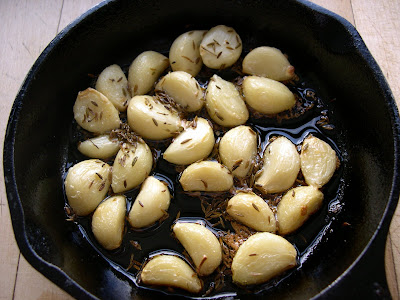
Place the garlic, cumin seeds, and toss in olive oil in a small cast iron pan. Place the pan in a 180C oven for 18-20 minutes, or until the garlic begins to turn lightly golden. There should be a complex smell of roast garlic, dominated by toasting cumin.


Near the end of roasting in the oven

Then add cold:

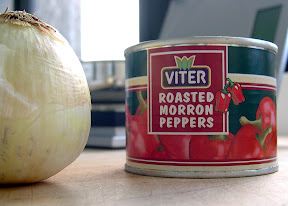
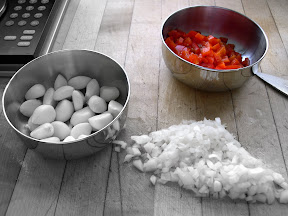
  • 100 gm drained Pimiento Morron (Vitter Brand) chopped
  • 60 gm diced fresh onion
  • 3-4 gm coarse salt
  • Strong dash of black pepper
  • Strong dash of crushed oregano leaves
  • 15-20 cc wine vinegar


Another great VITER S.A. product


Ready to toss together


Toss this mixture and let stand so the salt draws water from the onion and rehydrates the oregano.


Rising and forming


One-half the dough is left to rise in 1-hour periods (at 27C) while the other have is stretched on the board until it is 2-3cm thick. The pepper, onion, and garlic mix is spread on the stretched dough, draining as much liquid as possible. (Dusting the spread with flour at this point is also OK.)
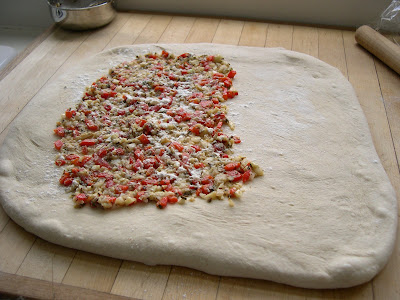
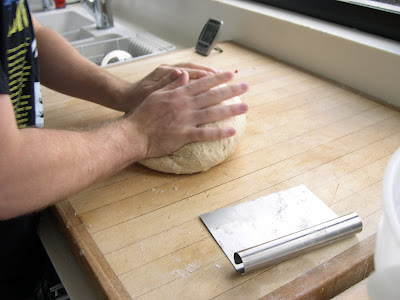


Then, fold the dough in half, and half again, and begin kneading by hand until the mixture is incorporated into the dough. This will be messy and needs frequent dusting with flour. It will be sticky on the bench! Mixing in this way allows good gluten formation and good yeast dispersion without disrupting the dough structure with vegetables or salt.


Near the end of hand kneading (~8 minutes)


This mix was also allowed to rise through two 1-hour risings and knock downs. At the end of the second rising, it looks like this:
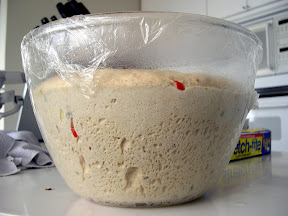


The garlic, pimiento, and onion dough was divided into 4 loaves of approximately 660gm each and placed in couchette to rise.
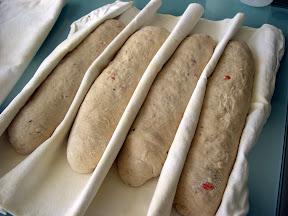
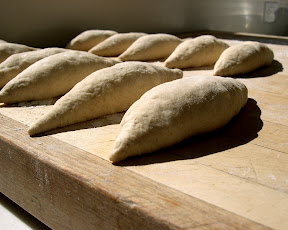
En couchette et en repose


Baking

Regular Italian rolls were rolled from boule into small pistolet type rolls, docked, and baked at 450F (232C). The loaves were carefully placed on baking screens, docked, and baked at the same temperature.

Baking time for rolls was approximately 15-18 minutes. Baking time for the loaves was approximately 22-25 minutes, rotating top rack with the bottom rack after 15 minutes.


Results

Bloom and color were excellent with a wonderful aroma when baking. The crumb was well formed with well defined pieces of garlic and pimiento.

Now, just go to Meats-and-More or La Ceiba, get some pavochón o lechón asado and have a sandwich.
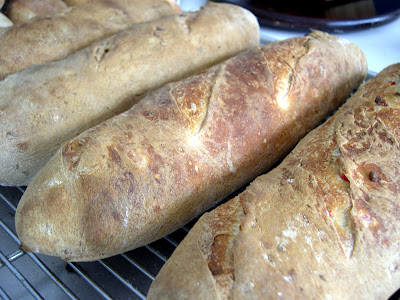
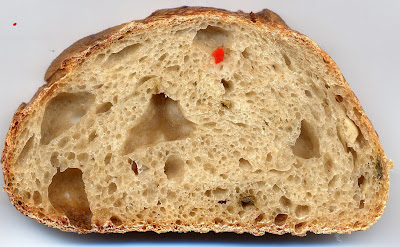


Magnificent crumb

Blacksmith Hell (part II)

In the search for flour, we found a bag of Pillsbury Whole Wheat Flour. The idea for today is to recreate a more rustic bread by mixing 10% whole wheat plus 90% of Amapola bread flour in a higher absorption ratio recipe of approximately 65% (65 parts water per 100 parts of total flour).

Pre-Treatment (biga)

The evening before, mix (this is a 60% absorption ratio):
  • 360 gm WW flour
  • 640 gm Amapola Harina por Pan
The above makes a total of 1000 gm of flour
  • 600 gm water
  • 8 gm La Vahiné yeast
The following morning, the biga, has fallen and is ready for mixing.


Mixing, and the overdose of whole wheat

The total recipe was designed around a 65% absorption ratio. Ideally this would mean:

  • 3600 grams of flour
  • 2340 grams water (0.65 x 3600 = 2340)
  • 72 grams salt (2% of flour weight)
  • yeast
Since 1000 gm of flour were already in the mix, all we needed was 2600 gm of bread flour.

We did not have 2600 gm of bread flour. And, since the only store that carries Amapola bread flour is 40 minutes away, the only option was to add whole wheat with this result.

  • 3600 gm flour = 360 WW + 800 WW (due to lack of bread flour) + 2440 gm bread flour
  • 2340 gm water
  • 72 grams salt
  • yeast

The overdose of whole wheat

So, rather than 10% whole wheat, we have 32% whole wheat. Whole wheat takes more water and so the dough becomes drier. The additional water that should have made the final bread very 'open' was used instead to wet the whole wheat. I have normal bread.


Rising, Forming and Filling

There is one divine ingredient that does exist in Puerto Rico that does not exist in other parts of the US and it is Tomate Frito. This is tomato sauce that has been fried in olive oil and spices until it thickens, then finished with a touch of real sugar (not high-fructose corn syrup). The result is a true ketchup, referring back to Carver's orginal recipes for the tomato. Add spices or chipotle peppers and you have an adult hot sauce.


The great Vitter Tomate Frito

A filling was made by olive oil sauteeing onions, garlic, and diced carrots (for sweetness), then adding a dash of habañero sauce and a can of Tomate Frito with additional sugar.


Sauteing onions, garlic, and carrots in olive oil


The dough was allowed to rise for 2 one-hour proofings at 27C with intermediate knock-downs.

Dividing was into a variety of forms:

  • 24 x 100 gm boules for filled rolls, made Parkerhouse style
  • 10 x 150 gm pizza discs that will be half baked, then frozen
  • 4 x 500 gm batons that will be stretched and made in to ciabatta
For a total of ~5900gm


First division of dough prior to weighing


Baking and finished product

The finished rolls were allowed to proof 20 minutes and baked in a 450F (230C) for 18 minutes. The pizza discs were coated with oil, vinegar, salt and pepper, then baked for 4 minutes to set the dough. Crumb was good, although unremarkable due to the overloading of the dough with whole wheat.


Coating pizza discs, partially baked discs, parkerhouse rolls filled with tomate frito


32% whole wheat--stringier bubbles, tighter crumb

ζ approves (albeit with an abscess)

Sunday, July 13, 2008

Blacksmith Hell

"There are large anvils and cold iron in blacksmith hell..."
Blacksmith at Sutter's Sawmill, near Coloma, California

Finally moved to Puerto Rico with nearly all of the kitchen goods including a new, large anvil:

The work area and the new anvil

The new Globe 10-quart puts all of the smaller KitchenAid toys to shame. It is nice having a kitchen mixer that can maim and cripple you, yet still whip cream.

Now, the only problem is that searching through nearly every supermarket (Grande, Pueblo, Amigo, etc.) bread flour does not exist. Wheat at 18 degrees north (even inter-planted with gandules, or pigeon peas) is not a crop, and the Spanish were more concerned with sugar cane, rum, tobacco, coffee, and gold. Wheat as a bread staple must have been replaced by local starches or corn, of which you can find large amounts at any market.

Finally, we found two bags of flour for "bread and pizza" made be Molinos de Puerto Rico. This enterprise was purchased by ConAgra several years ago, so, you get what you get.


Amapola (Hibiscus rosa sinensis) is a regional flower of Puerto Rico, originally from Japan, that became poplular in Europe in the 1700's. (Puerto Rico was settled by Ponce de Leon in 1508, so there was time for the amapola to be popularized at home, then sent to the colonies)

The label lists 3gm of protein per 30 gm of flour. Using the USDA calculation methods, this could mean 9.4-11% crude protein by weight, making it a mild bread flour. It lists free amylase as key dough modifier, versus malted barley flour. We experiment.

Pre-treatment

Make a non-yeast, AR 60%, dough to let the amylase do its work. This was done by mixing

  • 1kg Amapola harina por pan
  • 600gm water at room temperature, about 27C
Observing the mix shows that the dough is elastic after 4.5 minutes at first speed, and glossy after 7 minutes, suggesting that the peak on a farinograph would be 7-9 minutes. I do not expect MTI to be very broad (unless this is a repackaging of Buccaneer Brand Pizza flour).

This was left covered for 7 hours.

Mixing

The following morning, the pre-mix was firm with a slightly sweet-sour smell indicating some lactobacillus formation. Finger marks stayed in the dough.


The following completed the mix:

  • 8 gm Nea Magia (Greek yeast)
  • 600 gm water at 42C
  • About 8 gm sugar (no melao, even though it is made in Puerto Rico?)
Let proof for 20 minutes, then poured into pre-mix and paddled for 20 more minutes. Near the end of mixing added

  • 40gm salt, and allowed to dissolve
Finally, added 1kg of bread flour and mixed for 9 minutes on first speed.


Spiral hook works well on 3.2kg of AR 60%

Rising and Forming

As this was a test, nothing unique was attempted. The dough was allowed to rise at 27C for two, one-hour periods with intervening knockdowns. Yeast activity was very good and the dough more than doubled in bulk. Although the dough was slightly more sticky than a full 12-13% protein flour, there was good elasticity.

Dough was divided into 33 95-100 gm pieces, balled, and placed to proof for 20 minutes.


Points of view

The 33 balls were formed into equal numbers of rolls, braids, and flats.

Baking

The experiment was to bake on grilles at 450F, as our current oven is partially burned out and we are awaiting replacement. There are no baking stones in the oven.


Baking required 15-18 minutes for a good brown. This is about 50% more than a reasonable convection oven. However, the results were good:


Notes

The grilles give a good bloom, even though the speed of the oven is slower. Next month should arrive with a new convection oven we convinced the landlord to install.

Amapola bread flour needs more delicate handling as shown by the tearing of the braids as the bread bloomed. A stronger flour would have expanded. This means making braids or Kaiser style knots very loose with a good amount of flour to allow slippage.

Saturday, April 26, 2008

Coleman and Carver and Pizza


Mose Coleman grew onions. In 1931 Georgia, onion farmers were not paying their bills, but, Mose Coleman grew onions. At harvest, as I think all people who work with food will do, Mose cut one of the flat, yellow bulbs and tasted. This onion was sweet!

Part of the American dream is to prove to the world you can make lemonade when life deals you a lemon. But for Mose Coleman, he had to prove to the world you could do something with a sweet onion. Finishing the harvest, he began to sell his onions to the roadside passers-by. "Vidalia Sweet Onions", the onion that was not hot, the onion that was good in a cool summer salad, the onion that would perfectly match a fresh grilled hamburger... Mose Coleman ended the season selling Vidalia Sweet Onions for $3.50 a fifty pound bag, a remarkable price, and an industry was born.

Mr. Mose Coleman was white.

A few years before, George Washington Carver at the Tuskegee Institute, pondered how to remedy vitamin deficiencies in rural Alabama. He wrote "every normal person should make the tomato a very prominent part of the weekly diet". Inspired by his friend and co-worker Adella Hunt Logan, he published a circular on 115 ways to prepare the tomato for the table.

Mr. Carver was black.

Mose Coleman and Mr. Carver possibly never met. However, the onion Mr. Coleman cut on that summer day in 1931 and the tomato that Mrs. Logan convinced Mr. Carver was a solution to malnutrition had crossed several times in the prior 400 years...

The Crossings

Scientists do not know the exact origin of the tomato. However, if we believe Vavilov's theories, the region with the widest genetic diversity of a species will most likely be the area of its origin. If this is the case, tomatoes come originally from Peru, where numerous variants to Lycopersicon peruvianum are found growing as berry bushes. These berry bushes were carried north by natives so that by the time of the arrival of the Conquistadores in 1509, the Aztecs were making a mix of tomatoes and chiles as the first 'salsa'.

Cortez's scholars (for Cortez was only interested in gold) took the tomato back to Spain where it diffused through Europe, missing England. In Spain, the fruit was called pome del Moro, the Moor's apple (you could tell what was on their mind). The French, not understanding Spanish very well, corrupted this to pomme d'amour, the love apple (you could tell what was on their mind). The Italians shortened this further to pomodoro (mangia! mangia!), and published the first recipe using tomatoes in 1698. For some reasons, the English could not pronounce either the Spanish or French name and considered the tomato "rank and stinking", and so continued centuries of culinary excellence.


The onion that had been cut open in that Vidalia field in 1931, sighed, and recalled its beginnings as a transplant that came from Texas. If it could have remembered further, its ancestors came from Bermuda, an island whose human inhabitants were skilled at building fast schooners from native cedars. Fast schooners were good for trade, and the US Civil War made Bermuda a haven for smugglers and their providers who valued the anonymity of the island as well as the speed of their boats.

However, in the 1870's, smuggling had collapsed with the Southern states and Bermuda was in an economic crisis. A bright soul noted the islands temperate climate and a surplus of fast boats suggested Bermuda become New York's garden. Seven hundred sea miles separated the two, but this was only three days sail for the fast island schooners. A new industry was again born. Hamilton, the capital, was known as 'Onion Town' until another bright soul in Texas noted that they could also grow 'Bermuda' onions there.

The reason 'Bermuda' onions could be grown in Texas is that their seeds came from the Canary Islands, the world's source for onion seeds until 1949, since the Romans and Spanish brought the onion from Europe in 100 B.C.

Texas became the new onion capital of the western hemisphere by 1900. Its universities began to cross breed onions. One particular experiment crossed the 'Excel' onion from Valencia, Spain, with the 'Grano' Texas-Bermuda-Canary Islands onion to form the 'Granex'. Texans exported large quantities of Granex transplants (seeds were uncommon before the use of herbicides--weed seeds grew faster than onion seeds), one of which, when planted in the low-sulfur soil of Vidalia, Georgia, grew to be very sweet and unfortunately, would end its existence cut open by Mr. Mose Coleman.

Pre Treatment

We will prepare a standard 100:60 (60% AR) bread with the difference of using re-hydrated #1 bulgur to give the dough nutty wheat bits. The large size of the bulgur compared to wheat bran should protect the glutens and give an good rise and crumb.
  • 150 gm King Arthur Whole Wheat
  • 450 gm King Arthur All Purpose Flour
  • 360 gm water at room temperature
Mixed at second speed 7 minutes to form a thick dough

  • Bulgur #1 120gm rehydrated with 240 gm water

Both dough and re hydrated bulgur were maintained warm at 40C for 12 hours


Rehydrated #1 bulgur wheat


Mixing

Prepare a mixture of

  • 1800 gm water at 40C
  • 7 gm yeast La Vahiné
  • 30 gm melao
  • 72 gm salt (=3600 gm total flour @ 2%)
This is allowed to mix for 5 minutes, then blended with the bulgur and pre-treated flour using the paddle attachment for 20 minutes. At 5 minutes before the end of mixing, add the 72 gm of salt. The entire mixture should be foaming. Then:

  • Add 3kg of KA Bread flour
and mix using a dough hook for 7 minutes or as needed to meet the farinograph specification of the flour, typically 7-9 minutes.

Forming

La Vahiné is very slow yeast and it is used at about 0.2% concentration, well below the 'quick' recipes that use 1%. Therefore, this dough will need to rise and be knocked down repeatedly. Fortunately, all the risings add flavor and stretch gluten.

This batch rose (at 27C) 2.5 hours (real estate agent was here), 1 hour, and 1 hour before forming.

Formed into
  • 40 100 gm rounds= 4 kg +
    • of which 8 were formed as Parkerhouse rolls with a drop of tomato and onion paste in the center
  • 5 250 gm mini-loaves = 1.25 kg
  • 3 200 gm pizza rounds = 0.6 kg
The rounds were allowed to rise 40 minutes before being formed into French pistolet rolls and immediately baked.

The mini loaves rose for 40 minutes before docking and baking.

The pizza rounds were allowed to rise approximately 1 hour


Parkerhouse rolls looking at you


Baking

Rolls were baked at 230C for 12 minutes
Mini loaves were baked at 230C for 18 minutes (and could have used less)
Pizzas were baked at 230C for 9 minutes. (Unused rounds were baked for 4 minutes, then frozen for later use.)


Very good bloom and grigne on the stones


Thin sliced topping


Structure on a pizza is more interesting. Marinated tomatoes and onions will be moist and spicy and will resist the heat of baking, concentrating their flavors.

Use:

  • Two vine-ripened tomatoes (they should smell like the tiny hairs of the tomato leaf)
  • One half a larger Vidalia onion
  • Salt
  • Dried basil
  • Balsamic vinegar
Thinly slice the tomatoes and onions latitudinally. In a small bowl, layer tomatoes, salt sprinkled on the layer to taste, basil, then a layer of onion. Repeat until the bowl is nearly full, then add 15-30 ml of balsamic vinegar.

Allowing this mixture to stand for 2-3 hours will let the salt draw the water from the tomatoes and mix with the spices and balsamic vinegar.


Results


Parkerhouse rolls with a touch of tomato and onion paste baked inside


Mini loaves and raw pizza


Sunday, April 13, 2008

Secale Cerale (D=7)


Rye is alone. Rye is used to the cold steppes of northeastern Europe. It can be abused. The tiny kernel germinates, and in doing so, knows it will have a difficult life. Four root branches reach out for water; wheat (Triticum aestivum), the summer grain, has three. Dry, it survives. Cold, it survives. Rye sown on cold, over-cultivated soil can be 'eternal', giving a crop every year.

Rye is old, untouched. It is a diploid (2n) grain. Weeds are diploids. Weeds that crossed with emmer made wheat. Rye can remake itself with only 14 chromosomes. Wheat takes 42. Left alone, it returns to being weedy and invasive.

Rye does not waste. Its seed makes starch, and starch only for the next generation. There is no gluten and few other proteins that wait for milling and mixing to be turned into bread. Pliny the Elder, raised on the baking art of Roman Spain, scorned it, called it a poor food, "serving only to avert starvation."

Rye is Shiva. Its destruction is its creation. Within it, rye alpha-amylase is heat resistant, a strange thing for a plant used to cold winters. Left wet, rye begins to decompose its starches into sugars. With yeast, these form alcohol, and gave northern man beer, and when northern man met Arab science (al kohl), rye whiskey. With no yeast, the sugars met lactobacilli, which soured the rye, and conveniently, stopped the action of the amylase. No amylase, and the starches remained intact. Intact starches meant a loaf could be formed and baked. Northern man put down his beer and considered the problem...

Base recipe and approach

Rye amylases are more temperature stable and act upon the rye flour's starch structure, limiting dough strength. Amylase activity is inhibited at low pH, requiring the use of citric acid in the dough or by souring the dough in an anaerobic environment. (see p. 24 of Handbook of Dough Fermentation, CRC press/Google Books). The amylase activity and starch content of rye flour recommend a two step process:

  1. Add water and large quantities of yeast and let the 'porridge' mixture ferment between 20-30C for 24 hours. Lactic acid decomposition will make the mixture acid. Baker's yeast will keep activity in a lower pH medium. The intent is to have an acid yeast mixture for mixing into step 2. The classic term for this is the poolish.
  2. Mix the poolish into the remaining flour, adding some bread flour in this case for structure.
The mix below shows a very 'soupy' Poolish that becomes a 100:60 dough as the final ingredients are incorporated. All units are in baker's measures, with 100 begin equal to the total rye flour weight.

Ingredient Poolish Mixing Total As % of total flour
Rye Flour 55 45 100 100
Bread Flour 0 43 43
Water 53 33 86 60
Dry Yeast 3 1 4 3
Salt 0 3 3 2

Pre Treatment

The first water, yeast, and rye flour poolish was mixed at noon before the baking day. Some minor changes to the poolish were:

  • Adding a bit of regular bread flour (30gm) to take advantage of the barley malt. [This was due to a misunderstanding of rye flour chemistry. If anything, rye flour needs an amylase inhibitor rather than additional amylase.]
  • The yeast was proofed in 40C water with 10 gm of melao.
The poolish was allowed to ferment at 27-30 C for 20 hours.


First mixing of poolish

Ingredient Poolish Mixing Total
Rye Flour 480 gm 395 gm 875 gm
Bread Flour 0 gm 375 gm 375 gm
Water 465 gm 285 gm 750 gm
Dry Yeast 24 gm 12 gm 36 gm
Salt
25 gm 25 gm


After 2o hours at 27-30C, a foamy mass with a tart, pungent smell

Mixing

185 grams of a total 285 gm of water was heated to 40C, mixed with 10 gm of melao and yeast, then left 10 minutes to proof. After showing good activity, the liquid was added to the poolish with an additional 100 gm of pickle sour (a culture of 3% NaCl w/v with lactobacilli cultures taken from pickling vats). The intent of the sour was to add flavor. Unknowingly, the additional acid helped maintain the rye starch structure by inhibiting alpha-amylase activity.


Lactobcillus culture in salt from pickle vats

Mixing with a dough hook proved interesting as there are no gliadins or 'sticky' proteins to make the planetary dough hook on a Hobart K5SS 5-quart mixer 'grab' the dough. After five minutes of futile slapping of the dough hook, the dough was kneaded by hand for six minutes. Without glutens, the kneading made a homogeneous dough, but a dough without much strength.


Rising

With nearly 3% yeast the dough rises immediately. The dough more than doubled in volume in a sealed mixing bowl when proofed at 40C. The lack of gluten is obvious by the cracking of the dough ball:


There is no knockdown. Knockdown is useful in wheat doughs to 'stretch' the glutens and create further strength.

Forming and second rising

Dough was divided into 100gm boules and formed into balls. The balls were placed on oiled sheet pans and allowed to rise approximately one hour. As shown in the pictures below the boules expand nicely with a second rising of one hour at 27C.


Baking

The risen boules were delicate. You had to handle these carefully to avoid creating finger marks on the dough (that would not have been pushed out by baking). The rolls were placed lightly onto a peel dusted with rye flour and slid onto the baking hearth.

Rye breads are baked at a lower temperature and for longer periods than wheat doughs. The rolls were divided into four groups to test docking and steam injection. All bread was baked at 200C convection, with baking stones soaked for at least one hour at temperature. Baking time was 16 minutes.

Steam groups
  • Group 1 -- Baked on stone in boules
  • Group 2 -- Baked on stone with one slash (to test 'push')
Dry groups
  • Group 3 -- Baked on stone in boules
  • Group 4 -- Baked on stone with one slash
Results

There was little 'push'. The rolls elevated slightly from the baking stone or weakly broke open at the slash. The steam baked rolls had a darker crust, as expected, with a slightly more caramel aroma after baking. Weight loss in baking was about 5-7% for the steam injected baking and 10% for the dry baked rolls. The crumb was small and tight.


Steam injected (l) and dry baked (r)


Click on the picture for a close up

Next steps

  • Do not use bread flour in the poolish. This adds unneeded amylase. The rye flour has more than sufficient sugars to attract lactobacilli.
  • Think of adding the lactobacilli earlier in the poolish stage to start an culture to co-exist with the yeast.
  • Do not stress mixing. This bread has weak glutens. Stress keeping the starch structure intact and handling the dough delicately.